

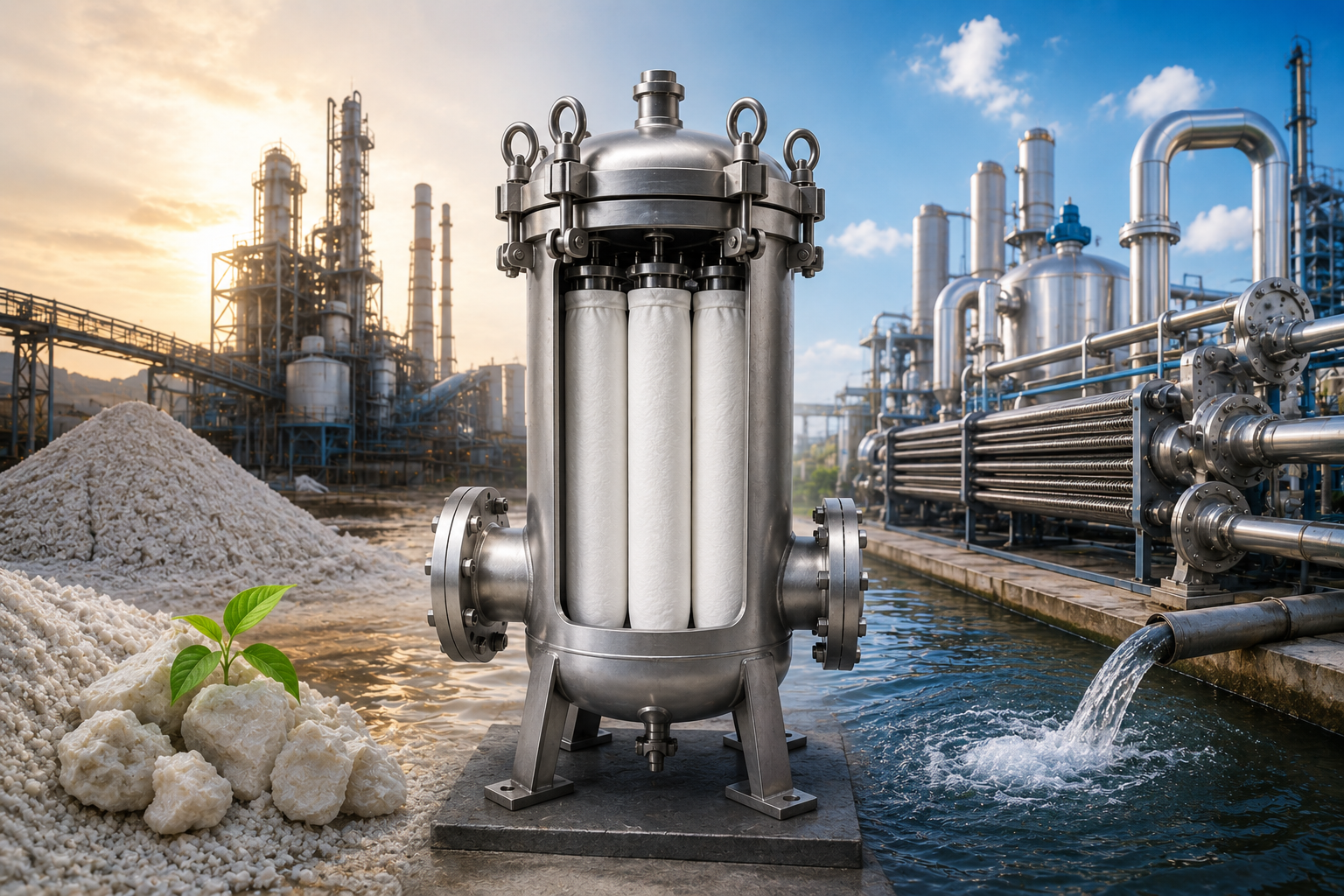
Phosphoric acid is the foundation of the global phosphate fertilizer industry — the intermediate that links phosphate rock through DAP, MAP, NPK, and SSP to the agricultural fields of every major food-producing nation. From Ma’aden’s integrated Wa’ad Al-Shamal complex (the world’s largest) to OCP Group’s Morocco operations, from Coromandel International’s Vizag plants to IFFCO Paradeep, from Paradeep Phosphates to GSFC Vadodara, wet-process phosphoric acid (WPA) production is one of the most filtration-intensive processes in chemical manufacturing.
What sits between the gypsum filtration press and the multi-effect evaporator that concentrates weak phosphoric acid (28–32% P₂O₅) to merchant-grade acid (52–54% P₂O₅) is,
in every well-engineered plant, an acid clarification filtration stage. Suspended gypsum fines, silica, and organic matter that escape the filter press foul evaporator heat exchanger tubes within weeks of operation. The downstream consequences — reduced evaporation capacity, increased steam consumption, premature evaporator cleaning, and ultimately P₂O₅ recovery losses that translate directly to plant economics — are uniformly underappreciated by plants that have lived with marginal clarification filtration for years. This article explains why a properly engineered Acid-Resistant Bag Filter Housing has become the global engineering standard for phosphoric acid clarification, and why it is one of the highest-payback retrofit investments available to phosphate plant managers today.
The Hidden Economics of Phosphoric Acid Clarification Failure
Three numbers drive the economics of phosphoric acid clarification, each one a meaningful line item on phosphate plant operating budgets.
Cost driver one: P₂O₅ recovery loss. Poor gypsum filtration and inadequate downstream clarification result in P₂O₅ carryover with the gypsum cake. Each 1% loss in P₂O₅ recovery at a 500 TPD P₂O₅ plant translates to USD 60,000 to 100,000 per year in direct revenue loss. Most plants we audit operate 0.5 to 2 percentage points below their theoretical recovery ceiling — a USD 30,000 to 200,000 annual gap that proper acid clarification filtration directly closes.
Cost driver two: evaporator heat exchanger fouling. Multi-effect evaporators concentrate weak phosphoric acid from 28% to 54% P₂O₅ across two to four evaporation stages. Suspended solids in unfiltered weak acid feed deposit on evaporator tube surfaces, reducing heat transfer coefficient and increasing steam consumption. The cumulative impact across a
500 TPD plant is USD 200,000 to 600,000 per year in additional steam cost, plus the operational disruption of acid descaling cycles every 4–6 weeks instead of the design 12 weeks.
Cost driver three: merchant-grade acid rejection. Merchant-grade phosphoric acid (MGA) sold to downstream DAP/NPK granulation customers is specification-tested for suspended solids content. Acid that fails this specification incurs a 15–25% price penalty on the rejected batch — a six-figure consequence on a single shipment. Plants supplying export markets face additional reputational consequences when MGA rejection events occur.
Why Generic Bag Filtration Fails on Phosphoric Acid Service
Weak phosphoric acid service combines three constraints that defeat any conventional bag filtration:
• Materials of construction incompatible with the acid chemistry. Weak phosphoric acid at 28–32% concentration contains residual sulphuric acid, free
fluoride (from rock phosphate), and trace HCl. Standard SS 316L housings suffer pitting and crevice corrosion within months. Carbon steel is non-viable. The engineered answer is Alloy 20 (Carpenter 20) or PVDF housing materials — the established global standard for phosphoric acid service that no generic bag filter supplier matches with confidence.
• Seal and gasket failure under fluoride exposure. Free fluoride in weak phosphoric acid attacks EPDM and standard nitrile seals within weeks. The engineered answer is PTFE or FKM (Viton) gaskets with documented fluoride resistance — a small specification detail that completely changes maintenance reality.
• Non-fluoride-compatible filter bag media. Generic polyester or polypropylene felt bags fail under fluoride attack at the elevated temperatures of weak phosphoric acid (60–80°C operating). The engineered answer is PP or PTFE filter bag media specifically certified for fluoride-containing acid service — again, specifications that distinguish purpose-engineered acid filtration from generic industrial supply.
Each of these failures individually shortens equipment life from years to months. Their combined effect is what produces the recurring acid-side maintenance issues at phosphate plants relying on cost-driven generic filtration suppliers.
The FCPL Solution: Acid-Resistant Bag Filter Housing for Phosphoric Acid Clarification
Filter Concept’s engineered industrial filter solution for phosphoric acid clarification is an Acid-Resistant Bag Filter Housing installed on the weak phosphoric acid line between the gypsum filtration press and the multi-effect evaporator feed. Every design element is matched to the corrosive reality of WPA service.
Alloy 20 or PVDF housing construction. FC-PDS™ selects the housing material from your actual acid composition data — residual sulphuric acid concentration, free fluoride level, chloride content, and operating temperature. Alloy 20 is the proven solution for high-fluoride service; PVDF is the alternative where capital cost optimization is critical and operating temperature is within the polymer rating. Optional EN 10204-3.1/3.2 material certification for European and African market jurisdictions.
Fluoride-resistant seals throughout. PTFE primary gaskets and FKM (Viton) secondary seals with documented fluoride resistance at operating temperature. This is the specification detail that separates housings that survive five-year service from housings that fail in the first year.
PP felt or PTFE filter bag media. 25-micron nominal bag media in acid-compatible polymer construction, selected per the actual particulate size distribution of your gypsum filter press effluent. Multi-bag configurations (4, 8, 16, 24 bag) sized to the weak acid flow rate and the downstream evaporator feed demand. Optional fluoride-resistant gasket compounds at each bag-to-housing interface.
Multi-bag configuration for continuous service. Phosphoric acid evaporators run continuously — single-bag housings forcing periodic offline cleaning are operationally unworkable. Multi-bag designs provide the parallel capacity needed for in-service bag changeout while maintaining flow to the evaporator. Quick-release closure designed for safe acid-service operator handling with full PPE protocols.
FC-PDS™ specification methodology. Bag micron rating, count, and changeout frequency are specified from your actual gypsum filter press performance, weak acid flow rate, and evaporator feed quality requirement. Site-specific engineering produces sustained P₂O₅ recovery and predictable evaporator service intervals — the operational reality that distinguishes well-run phosphate plants globally.
Engineering Specifications at a Glance
| Parameter | Specification |
| Housing Material | Alloy 20 (Carpenter 20) or PVDF — specified per acid composition |
| Filter Media | PP felt or PTFE bags — 25 micron nominal (fluoride-resistant) |
| Configuration | Multi-bag (4, 8, 16, 24 bag) sized to weak acid flow rate |
| Gasket Material | PTFE primary · FKM (Viton) secondary — fluoride-resistant |
| Flow Rate | 10 to 200 ms/hr (matched to evaporator feed demand) |
| Operating Pressure | Up to 6 bar |
| Operating Temperature | 60 to 80°C (weak phosphoric acid service) |
| Acid Composition Compatibility | 28–32% P₂O₅, residual H₂SO₄, free fluoride 1–3%, trace HCl |
| Outlet Suspended Solids | Less than 100 ppm (evaporator-grade) |
| Pressure Vessel Code | ASME Section VIII Div. 1 / PED 2014/68/EU compatible |
| Closure Type | Acid-rated bolted closure with safety vent and drain |
| Service Model | Retrofit + FaaS (bag replacement on DP rise — high-frequency acid-side consumable) |
Global Standards & Regional Compliance Matrix
Phosphoric acid clarification filtration sits at the intersection of corrosive service pressure equipment safety, environmental regulation (particularly fluoride emissions), and global fertilizer industry technical standards. The FCPL Acid-Resistant Bag Filter Housing is engineered to international baselines with regional certifications added per destination market:
| Region / Cluster | Applicable Standards & Regulations |
| International (Universal) | ASME Section VIII Div. 1 · NACE MR0175 / ISO 15156(where applicable) · ISO 14001 environmental management · IFA (International Fertilizer Association) technical standards · IFC EHS Guidelines for Phosphate Fertilizer Manufacturing |
| North America | ASME BPVC · EPA NSPS Subpart V (phosphate fertilizer) · OSHA PSM 29 CFR 1910.119 · EPA Resource Conservation & Recovery Act |
| Europe | PED 2014/68/EU · EN 13445 · EU Fertilizing Products Regulation 2019/1009 · EU Industrial Emissions Directive · REACH Regulation |
| Middle East & GCC | Saudi Aramco SAES (where applicable to Ma’aden ops) · SASO conformity · Ma’aden technical specifications · GSO conformity |
| Africa | OCP Morocco technical specifications · JPMC Jordan standards · SABS (South Africa) · NESREA (Nigeria) for environmental compliance |
| Asia-Pacific & India | Fertiliser (Control) Order 1985 (India) · IS 6072 (DAP) · IS 2585 (Superphosphates) · CPCB Fluoride Emission Standards · MoEF Hazardous Waste Rules 2016 · PESO Pressure Vessel Rules · PETRONAS / PT Petrokimia (SE Asia) |
| Latin America | Brazil ABNT NBR phosphate standards · ANP regulations · INMETRO compliance · Mosaic do Brasil specifications |
Two frameworks deserve specific attention. The International Fertilizer Association (IFA) technical guidelines have become the de facto global reference for phosphate plant engineering, referenced by major operators and EPC contractors regardless of jurisdictional statutory framework. The IFC EHS Guidelines for Phosphate Fertilizer Manufacturing set the universal environmental performance benchmark for greenfield phosphate capacity. The FCPL housing is engineered to satisfy both — making it quantifiable across Ma’aden, OCP, JPMC, Mosaic, and the major Indian phosphate producers as a specification-grade supplier.
